


THE JOURNAL ADOMBRAMENTI
Adombramenti – Journal of Phenomenological Psychology is the thematic journal of Psicofen – Association for Phenomenological Psychology and Mental Health. It offers a space for scientific research, philosophical reflection, narrative, and critical dialogue on mental health and phenomenological psychology. The next issue of the journal will be published by Mimesis Edizioni.
Theme of issue: the living body
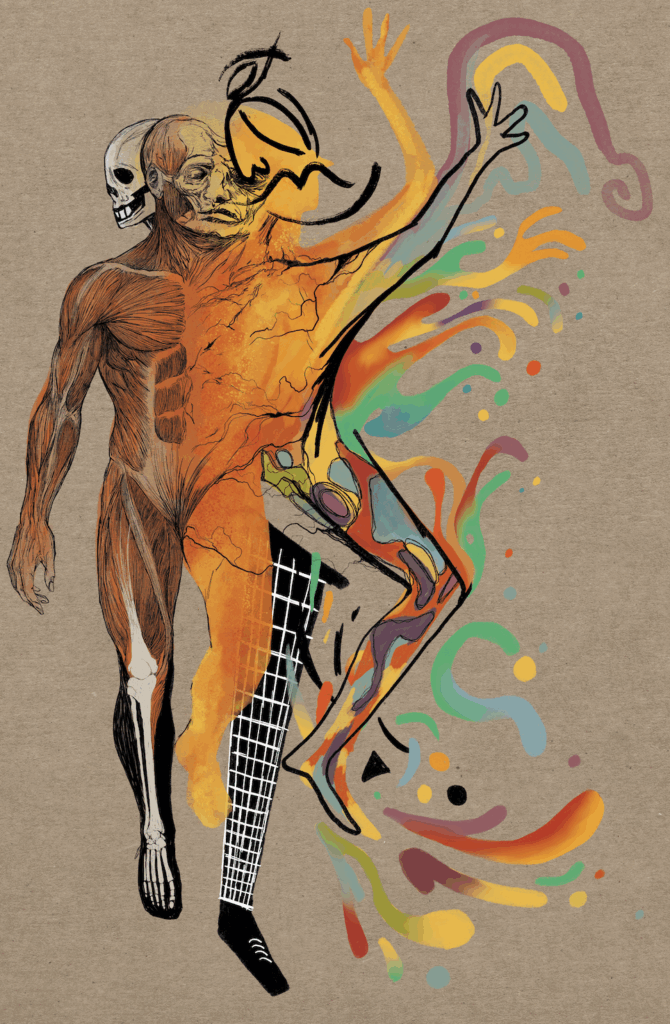
One of the core contributions of phenomenology lies in its attempt to overcome the Cartesian dualism between psyche and soma, proposing instead the body as the vehicle through which we are brought into the world, through which the world is disclosed to us, and by which we are constituted. The body described by phenomenology is not the anatomical body (Körper), a thing among other things, but the Leib — the lived, living body. Leib is what makes us present, delivers us into the world, allowing us to project ourselves in and with it. It is thus the condition of possibility for any experience and relationship.
To fully embrace the intrinsic complexity of this perspective, it is necessary to adopt an intersectional theoretical and practical posture — one capable of avoiding both individualistic and reductionist positions and of illuminating the interplay between embodied experience and structural oppression, between corporeal life and multiple forms of belonging.
In this issue of Adombramenti, published in collaboration with Mimesis Edizioni, we invite authors to reflect on the lived body as a space where vulnerability and expression, norms and possibilities, care and control intersect. Our aim is to create a transdisciplinary space in which phenomenology can engage with other forms of knowledge that nourish not only its theoretical framework but, above all, its transformative potential in practice.
Submissions must be sent to adombramenti@psicofen.com or uploaded via the form at the bottom of this page by October 1st, 2025.
THEMATIC TRAJECTORIES
Bodies, Psychopathological Experience, and Clinical Practice
How is bodily experience (individual and/or social) shaped in various psychopathological conditions within psychiatric and psychotherapeutic settings?
Bodies in Transition
From the impact of bodily changes during life-cycle transitions and vulnerabilities to the affirmation or denial of bodily rights at the end of life.
Institutionalized Bodies
How can we understand bodily experiences marked by segregation, surveillance, resistance, and anonymity within contemporary total institutions (prisons, migrant detention centers, psychiatric hospitals)?
Bodies in Relation and Relations of Care
We call for analyses of power and reciprocity in care relationships (professional and otherwise), beginning with reflections on the bodies of caregivers and those being cared for.
Anthropology of Bodies
How is the encounter between body and world inhabited in cultures different from the Western one? How can anthropological knowledge help us grasp alternative relational modalities between individual and/or social bodies?
Bodies and Gender
From the lived (or imposed) corporeality in queer and gender-diverse experiences, to masculine and feminine embodiment, from the socio-cultural and political impact of heteronormativity to the political affirmation of non-conforming bodies.
Sexualized Bodies
From the body as an object/subject of individual desire to its sexualization in contemporary socio-cultural contexts.
Ecology of Bodies and Urban Architecture
What are the relationships between the human body and its environment? From the impact of pollution, ecological collapse, and environmental insecurity on health and the body to the bodily possibilities and constraints shaped by urban architecture.
Bodies in Artistic Experience
From the body as artwork or creative instrument of transformation (individual and/or collective) to its relevance in therapeutic practices through artistic experience.
Virtual Bodies and Psychotherapy
We address clinical practices mediated by technology, with specific attention to how bodily presence and therapeutic encounters are transformed.
Artificial Bodies and Technological Impact
How do algorithms shape bodies, identities, and perceptions? What tensions arise between human presence and technological simulation?
WHO CAN SUBMIT
We welcome contributions from:
Professionals working in the field of mental health
(psychologists, physicians, social workers, nurses, educators, healthcare assistants)
Practitioners and scholars in the humanities and social sciences
(philosophers, sociologists, anthropologists, pedagogues)
Practitioners from fields adjacent to health and society
(architects, legal professionals)
Citizens with a cultural, artistic, or political interest in the themes proposed
Individuals with lived experiences and personal testimonies relevant to the issue
SUBMISSION GUIDELINES
Please submit your contribution by October 1st, 2025 via info@psicologiafenomenologica.it or through the online form.
Submissions must be sent in .doc, .docx, or .pdf format and include the following:
A brief abstract (200–300 words)
Thematic trajectory or trajectories your submission addresses
A short bio (max. 100 words) and a half-length portrait photo
The full contribution (max. 8 pages including references)
Font: Times New Roman, 12 pt
Line spacing: single
Margins: 2.5 cm on all sides
A separate bibliography, formatted in APA style, listed alphabetically
Example:
Parker, I. (2017). Marxist theory and psychotherapy. In Routledge International Handbook of Critical Mental Health (pp. 244–250). Routledge.
Contributions must be original and not submitted or published elsewhere.
All submissions will undergo a double-blind peer review process by members of the journal’s scientific committee. Authors may be asked to revise their work before acceptance.
The journal is published by Mimesis Edizioni.


Submissions must be sent to adombramenti@psicofen.com or uploaded via the form at the bottom of this page by October 1st, 2025.